 Zum Inhalt springen
Überprüft vom Rapidcision-Entwicklungsteam | Letzte Aktualisierung: Juni 2026
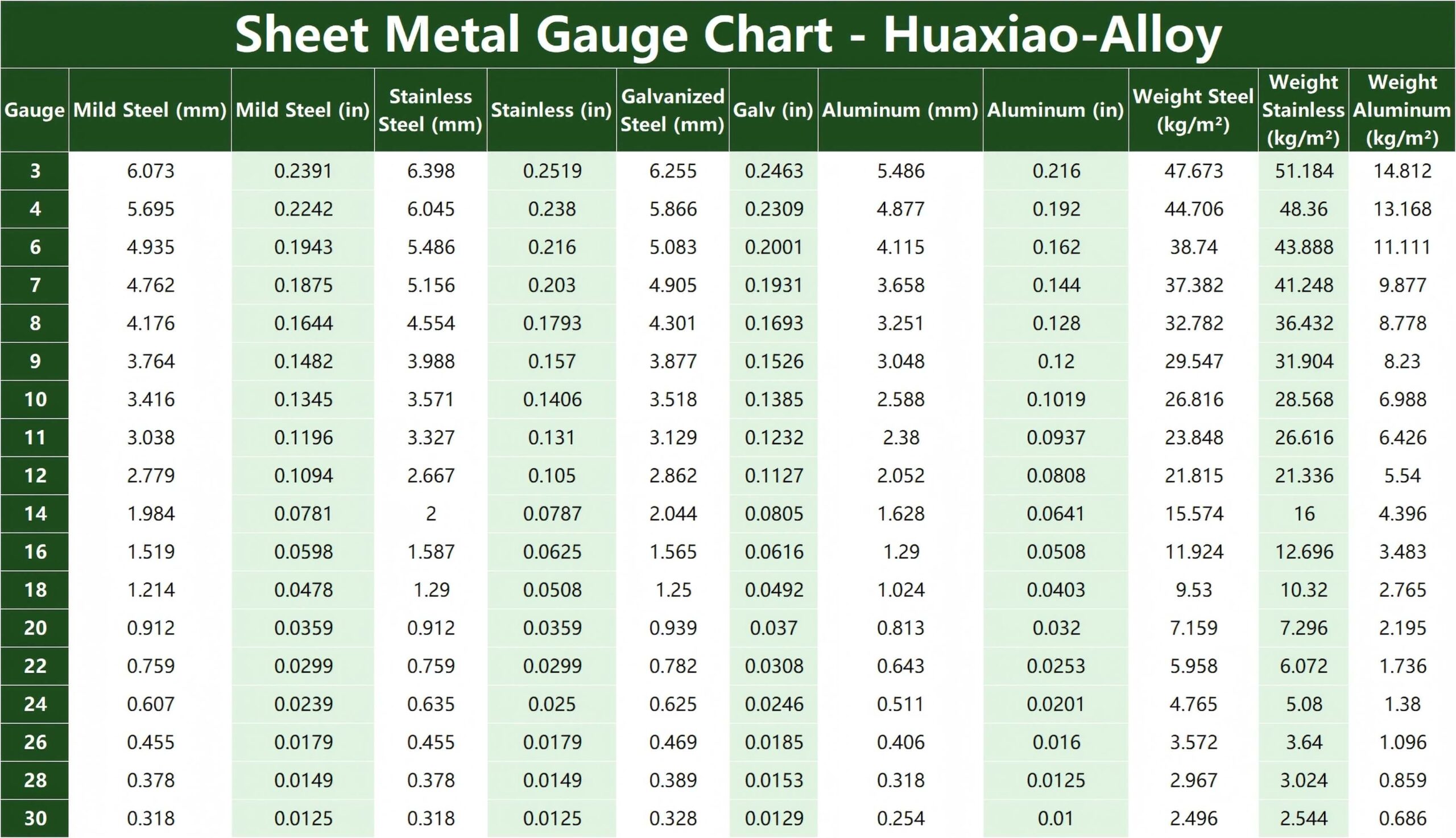
A sheet metal gauge is a number that indicates the thickness of a sheet, where a higher gauge number means a thinner sheet. The catch that trips up engineers and buyers is that the same gauge number is not the same thickness across different metals. An 18-gauge stainless steel sheet, an 18-gauge mild steel sheet, and an 18-gauge aluminum sheet are all different thicknesses, because the gauge systems were built separately for ferrous and non-ferrous metals. The chart below gives the actual thickness for each common gauge in steel, galvanized steel, stainless steel, and aluminum, in both inches and millimeters.
Use it to translate a gauge callout into a real dimension, to compare materials, and to avoid the costly mistake of assuming a gauge number carries the same thickness from one metal to the next. We work to these standards across our sheet metal fabrication services.
Sheet Metal Gauge Thickness Chart
Thicknesses are shown as inches with the millimeter equivalent in parentheses. Steel, galvanized, and stainless follow the Manufacturers’ Standard Gauge; aluminum follows the Brown and Sharpe (American Wire Gauge) system.
| Gauge | Mild Steel | Galvanized Steel | Rostfreier Stahl | Aluminium |
| 7 | 0.1793 (4.55) | — | 0.1875 (4.76) | 0.1443 (3.67) |
| 8 | 0.1644 (4.18) | 0.1681 (4.27) | 0.1719 (4.37) | 0.1285 (3.26) |
| 9 | 0.1495 (3.80) | 0.1532 (3.89) | 0.1563 (3.97) | 0.1144 (2.91) |
| 10 | 0.1345 (3.42) | 0.1382 (3.51) | 0.1406 (3.57) | 0.1019 (2.59) |
| 11 | 0.1196 (3.04) | 0.1233 (3.13) | 0.1250 (3.18) | 0.0907 (2.30) |
| 12 | 0.1046 (2.66) | 0.1084 (2.75) | 0.1094 (2.78) | 0.0808 (2.05) |
| 13 | 0.0897 (2.28) | 0.0934 (2.37) | 0.0938 (2.38) | 0.0720 (1.83) |
| 14 | 0.0747 (1.90) | 0.0785 (1.99) | 0.0781 (1.98) | 0.0641 (1.63) |
| 15 | 0.0673 (1.71) | 0.0710 (1.80) | 0.0703 (1.79) | 0.0571 (1.45) |
| 16 | 0.0598 (1.52) | 0.0635 (1.61) | 0.0625 (1.59) | 0.0508 (1.29) |
| 17 | 0.0538 (1.37) | 0.0575 (1.46) | 0.0563 (1.43) | 0.0453 (1.15) |
| 18 | 0.0478 (1.21) | 0.0516 (1.31) | 0.0500 (1.27) | 0.0403 (1.02) |
| 19 | 0.0418 (1.06) | 0.0456 (1.16) | 0.0438 (1.11) | 0.0359 (0.91) |
| 20 | 0.0359 (0.91) | 0.0396 (1.01) | 0.0375 (0.95) | 0.0320 (0.81) |
| 22 | 0.0299 (0.76) | 0.0336 (0.85) | 0.0312 (0.79) | 0.0253 (0.64) |
| 24 | 0.0239 (0.61) | 0.0276 (0.70) | 0.0250 (0.64) | 0.0201 (0.51) |
| 26 | 0.0179 (0.45) | 0.0217 (0.55) | 0.0187 (0.48) | 0.0159 (0.40) |
| 28 | 0.0149 (0.38) | 0.0187 (0.47) | 0.0156 (0.40) | 0.0126 (0.32) |
| 30 | 0.0120 (0.30) | 0.0157 (0.40) | 0.0125 (0.32) | 0.0100 (0.25) |
Millimeter values are converted from the standard inch thicknesses and rounded to two decimals. Galvanized sheet thinner than 8 gauge is uncommon at the heavy end, so 7-gauge galvanized is left blank.
Why Gauge Differs by Material
The reason a gauge number shifts thickness between metals is historical. Gauge systems grew out of wire drawing, where wire was once sold by weight, and different industries standardized differently. Two systems still govern sheet metal today.
Carbon steel, galvanized steel, and stainless steel use the Manufacturers’ Standard Gauge. Aluminum and other non-ferrous metals such as brass and copper use the Brown and Sharpe Gauge, also known as the American Wire Gauge. Because these systems were defined independently, a 16-gauge mild steel sheet is about 1.52 mm, while a 16-gauge aluminum sheet is about 1.29 mm. You cannot convert a gauge directly from one metal to another. Always read the thickness from the column for the specific material you are using.
Galvanized steel is also slightly thicker than uncoated steel at the same gauge, because the zinc coating bonded to the steel adds to the measured thickness.
Choosing the Right Gauge for the Job
Gauge selection balances strength, weight, formability, and cost. As a general guide:
- Thin sheets, roughly 20 to 30 gauge. Used for ductwork, light enclosures, decorative panels, and parts where weight savings matter more than load-bearing strength.
- Medium sheets, roughly 14 to 19 gauge. Common in automotive parts, appliances, brackets, and furniture, where moderate strength meets reasonable formability.
- Thick sheets, roughly 7 to 13 gauge. Suited to structural components, heavy enclosures, and machinery frames that carry real load.
Thicker material costs more and is harder to bend, but it adds strength and durability. Match the gauge to the structural and functional demands of the part rather than defaulting to a familiar number.
Gauge vs Actual Thickness: A Caution
Gauge denotes a standard nominal thickness before processing, not a guaranteed exact dimension. Real material carries mill tolerances, and finishing such as polishing or applied films can change the final thickness slightly. Sheets are rolled to size, and roller crowning often leaves the edges a touch thinner than the center.
For precision fabrication, the safest practice is to specify thickness in millimeters or decimal inches, along with the governing standard, rather than relying on a gauge number alone. For example, 304 stainless ordered to ASTM A480 carries a defined thickness tolerance, so calling out the standard on the drawing or purchase order removes ambiguity. This matters most when parts have to fit, weld, or stack to tight assemblies, where a few hundredths of a millimeter can affect fit-up.
Wo Rapidcision zum Einsatz kommt
Rapidcision fabricates sheet metal parts across steel, stainless, aluminum, and galvanized, and we work from your specified thickness and standard so the part matches your drawing rather than a loose gauge assumption. Upload a design and our instant-quote workflow returns pricing and DFM feedback, including guidance on material and gauge selection. You can review capability on our sheet metal fabrication page or Hier ein Angebot anfordern.
Häufig gestellte Fragen
Is 16 gauge thicker than 18 gauge? Yes. A lower gauge number means a thicker sheet, so 16 gauge is thicker than 18 gauge. In mild steel, 16 gauge is about 1.52 mm while 18 gauge is about 1.21 mm.
Is 16-gauge steel the same thickness as 16-gauge aluminum? No. They use different gauge systems. A 16-gauge mild steel sheet is about 0.0598 inch (1.52 mm), while a 16-gauge aluminum sheet is about 0.0508 inch (1.29 mm). Always use the chart column for your specific metal.
What thickness is 18-gauge steel? In the Manufacturers’ Standard Gauge, 18-gauge mild steel is 0.0478 inch, which is about 1.21 mm. Galvanized 18 gauge is slightly thicker at about 1.31 mm because of the zinc coating.
Why is galvanized steel thicker than regular steel at the same gauge? Galvanizing bonds a layer of zinc to the steel, and that coating adds to the measured thickness. So galvanized sheet reads slightly thicker than uncoated steel of the same gauge.
Why do different metals use different gauge systems? The systems developed separately. Carbon steel, galvanized, and stainless use the Manufacturers’ Standard Gauge, while aluminum and other non-ferrous metals use the Brown and Sharpe (American Wire Gauge) system, reflecting different industry histories and material properties.
Should I specify gauge or actual thickness? For precision work, specify the actual thickness in millimeters or decimal inches plus the governing standard. Gauge is a nominal value with mill tolerances, so a precise callout avoids fit and welding problems.
Using the Chart
The key takeaways: a higher gauge is a thinner sheet, gauge thickness changes by material, and for precision parts you should specify a real dimension and standard rather than a gauge number alone. Keep this chart handy for translating callouts and comparing materials at a glance.
If you have a sheet metal part to make, upload your design for an instant quote. We will confirm the right material, gauge, and thickness for your application and return DFM feedback with your pricing.