
Rapidcisionエンジニアリングチームによるレビュー | 最終更新日:2026年6月
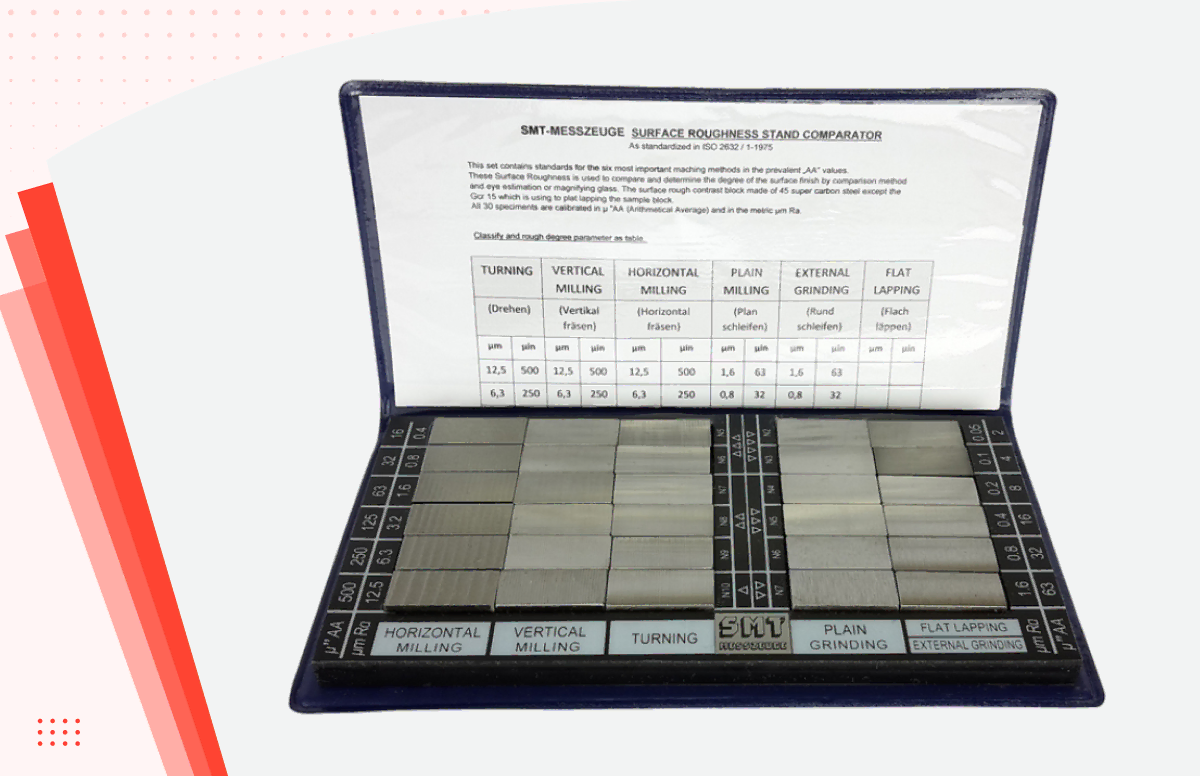
Surface roughness is the microscopic texture of peaks and valleys left on a part after machining, and Ra is the number used to specify it on most drawings. The practical anchor points are simple: Ra 3.2 µm is the standard, economical finish straight off a CNC mill or lathe, and Ra 1.6 µm is the usual threshold for precision mating surfaces. Anything smoother than that climbs in cost quickly, because it takes finer tooling, slower feeds, or a secondary process like grinding. The conversion chart below lets you move between Ra, Rz, RMS, and the older N-grade system, and the process table shows what each machining method can realistically achieve.
Specifying the right finish is a balance of function and cost, and getting it wrong in either direction is expensive. We hold surface finish to drawing across our CNC加工サービス, and the guidance here will help you call out a finish that performs without overpaying for smoothness you do not need.
What Ra Actually Measures
Ra, the arithmetic average roughness, is the average absolute deviation of the surface profile from its mean line over a measured length. A lower Ra means a smoother surface. It is the most common parameter on engineering drawings because it gives a single, repeatable number that correlates well with how a surface performs for friction, wear, sealing, and fatigue.
Ra has limits worth knowing. Because it is an average, a single deep scratch barely moves the Ra value even though that scratch could let fluid leak straight through a sealing surface. That is why some applications also specify Rz, which captures peak-to-valley height and is more sensitive to individual defects.
Ra, Rz, RMS, and N-Grade Conversion Chart
The N-grade system follows ISO 1302, where N1 is the smoothest and N12 the roughest. Most CNC machined features land in the N7 to N8 range, which is Ra 1.6 to 3.2 µm. Convert microns to microinches with 1 µm ≈ 39.37 µin. RMS runs about 11 percent higher than Ra, so multiply Ra by about 1.11. Rz shown here is a general approximation of roughly four times Ra and should be treated as a reference only.
| N-Grade | Ra (µm) | Ra (µin) | Rz approx (µm) |
| N1 | 0.025 | 1 | 0.1 |
| N2 | 0.05 | 2 | 0.2 |
| N3 | 0.1 | 4 | 0.4 |
| N4 | 0.2 | 8 | 0.8 |
| N5 | 0.4 | 16 | 1.6 |
| N6 | 0.8 | 32 | 3.2 |
| N7 | 1.6 | 63 | 6.3 |
| N8 | 3.2 | 125 | 12.5 |
| N9 | 6.3 | 250 | 25 |
| N10 | 12.5 | 500 | 50 |
| N11 | 25 | 1000 | 100 |
| N12 | 50 | 2000 | 200 |
Actual finish depends on material, tooling, speed, feed, and coolant, so always verify a critical surface with a profilometer rather than assuming the nominal value.
Achievable Ra by Machining Process
Each process has a realistic Ra range. Asking a process to go below its natural range means adding operations and cost.
| Process | Typical achievable Ra (µm) |
| CNCフライス加工 | 1.6 to 6.3 |
| CNC turning | 0.8 to 3.2 |
| Grinding | 0.2 to 1.6 |
| ワイヤー放電加工機 | down to about 0.1 |
| Lapping / superfinishing | below 0.1 |
A common and costly mistake is specifying a very smooth finish, such as Ra 0.4 µm, on a part that will only see a standard 3-axis mill. Hitting that value forces grinding or polishing after machining, which can double or triple machining time. If your finish requirement sits below what milling or turning delivers, plan for the extra process and cost up front.
Common Ra Values and What They Are For
- Ra 3.2 µm (125 µin, N8). The standard, economical finish off a CNC mill or lathe with normal feeds and speeds. Fine for most general surfaces.
- Ra 1.6 µm (63 µin, N7). The practical standard for precision milling. Tight enough for many press-fits and sliding surfaces without abrasive finishing.
- Ra 0.8 µm (32 µin, N6). Achievable on capable machines with sharp tooling and reduced step-overs, at higher cycle time. Common for better sealing and bearing surfaces.
- Ra 0.4 µm and finer (N5 and below). Usually requires grinding, polishing, or lapping. Reserve for true sealing faces, optical, or high-precision surfaces, and confirm feasibility against the material.
Finish, Cost, and Coatings
Roughness and cost are inversely related. As the target Ra drops, machining time rises sharply, since finer finishes need slower feeds and often additional operations. The smart approach is to relax the finish on surfaces that do not need it. For example, on a hydraulic manifold, holding a tight Ra only on the sealing faces and valve seats while letting non-contact passages run at a coarser finish can cut machining time and finishing cost substantially with no loss of function.
Post-processing also changes the surface. Standard anodizing tends to raise Ra slightly because of its micro-etching, while heavier electroplating can smooth microscopic peaks. If your final assembly has a strict Ra requirement, account for the coating by specifying the surface allowance before plating or anodizing.
Rapidcisionの活用シーン
When you specify a finish on your drawing, we machine and inspect to it, and our DFM feedback will flag any surface called out smoother than its process can reach economically, so you can decide whether the cost is justified before production. Our standard milling and turning naturally reach the Ra 1.6 to 3.2 µm range, with finer finishes available through additional operations where your part needs them. See how tolerances pair with finish on our CNC machining tolerance chart, review how wire EDM reaches very fine finishes, or upload your CAD file for a quote.
よくある質問
What is Ra in surface roughness? Ra is the arithmetic average roughness, the average deviation of a surface profile from its mean line over a measured length. It is the most common way to specify surface finish on drawings, where a lower Ra means a smoother surface.
What is a good surface finish for CNC machining? Ra 3.2 µm is the standard economical finish off a mill or lathe, and Ra 1.6 µm is the common threshold for precision mating surfaces. Most CNC features fall in the N7 to N8 range, which is Ra 1.6 to 3.2 µm.
How do I convert Ra to RMS? RMS is about 11 percent higher than Ra for most machined surfaces, so multiply Ra by approximately 1.11 to estimate RMS. To convert microns to microinches, multiply by 39.37.
What is the difference between Ra and Rz? Ra is an average deviation, while Rz measures peak-to-valley height. Because Ra averages out individual defects, Rz is more sensitive to single deep scratches, which matters for sealing surfaces.
What surface finish can each process achieve? CNC milling typically reaches Ra 1.6 to 6.3 µm, turning 0.8 to 3.2 µm, and grinding 0.2 to 1.6 µm. Wire EDM and lapping can go finer, down to about 0.1 µm or below.
Why does a smoother finish cost more? Lower Ra requires slower feeds, finer tooling, and often secondary operations like grinding or polishing, which raise machining time sharply. Specifying a tight finish only where it is needed keeps cost down.
Using the Surface Roughness Chart
Surface finish is a balance of performance and cost. Use the conversion chart to translate between Ra, Rz, RMS, and N-grades, match your target to a process that can reach it, and specify a tight finish only on the surfaces that truly need it. Ra 3.2 µm and Ra 1.6 µm cover the large majority of machined parts at sensible cost.
If you have a part with specific finish requirements, upload your drawing for a quote. We will confirm the achievable finish for your process and material and flag anything worth relaxing to save cost.