 Zum Inhalt springen
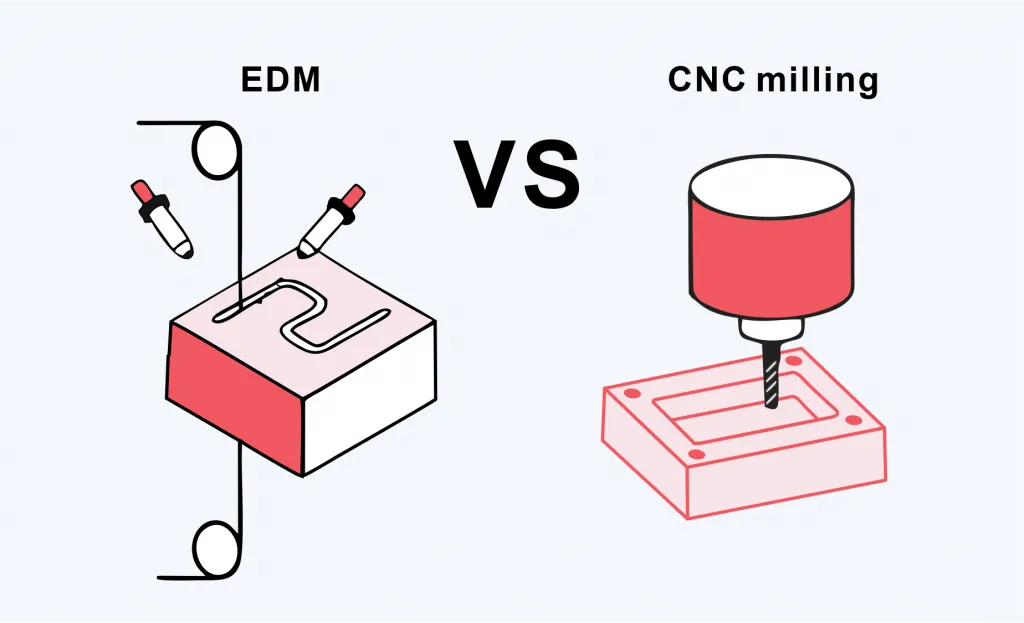
Wire EDM (Electrical Discharge Machining) cuts conductive metals using a thin brass or coated wire that creates rapid electrical sparks across a dielectric fluid gap. The process produces ±0.0025 mm tolerances, sharp internal corners with 0.10 mm radius, and surface finishes down to Ra 0.2 µm — without imposing cutting forces on the part. Wire EDM beats CNC milling for hardened tool steels, intricate aerospace and medical geometries, and any feature where a cutter physically cannot reach.
Wire EDM at a Glance
| Parameter | Standard Capability | Premium Capability | Best Application |
|---|---|---|---|
| Dimensional Tolerance | ±0.013 mm | ±0.0025 mm | Aerospace splines, medical tools |
| Surface Finish (Ra) | 1.6 µm typical | 0.2 µm with skim cuts | Mating surfaces, optical mounts |
| Min Internal Corner Radius | 0.15 mm (0.20 mm wire) | 0.05 mm (0.10 mm wire) | Sharp punch and die work |
| Max Material Thickness | 300 mm typical | 500 mm specialty | Aerospace bulkheads, mold blocks |
| Cut Speed | 150–250 mm²/min | Up to 500 mm²/min (rough) | Production cycles |
| Material Hardness | Up to 65 HRC standard | Up to 70 HRC tungsten carbide | Tool steel, carbide dies |
How Wire EDM Actually Works
A wire EDM machine threads a thin wire — typically 0.10 to 0.30 mm diameter brass or zinc-coated brass — through a starter hole or open edge in the workpiece. The wire is held under tension between an upper and lower guide. A power supply applies controlled high-frequency voltage pulses (10,000–250,000 Hz typical) between the wire and the workpiece, both submerged in deionized water dielectric.
Each pulse creates a tiny spark that vaporizes a microscopic crater in the workpiece. The dielectric flushes the debris away. The wire never touches the part — there’s a 0.025–0.040 mm gap maintained by the spark plasma. The wire feeds continuously from a spool because each spark erodes some of the wire as well, so the wire is consumable.
The result is a precise cut with no cutting force on the part. Hardened steel, Inconel, titanium, carbide — anything conductive — cuts the same way. Hardness is irrelevant to the process. That single property is what makes wire EDM essential in tool-and-die work and many aerospace applications.
Where Wire EDM Beats CNC Milling
Hardened Tool Steels
CNC milling A2, D2, M2, or H13 tool steel above 50 HRC requires aggressive carbide tooling, shallow depths of cut, and frequent tool changes. Wire EDM cuts the same hardened steel at the same rate as soft material — typically 180–220 mm²/min cut speed regardless of hardness up to 65 HRC. For die makers, this means roughing and finishing in a single setup after heat treatment, eliminating heat-treat distortion problems.
Sharp Internal Corners
CNC milling can only cut an internal corner as sharp as the smallest endmill that fits — typically 0.5 mm radius minimum on production work. Wire EDM produces internal corners with radii of 0.10 mm or smaller (matching the wire diameter plus the spark gap). For aerospace splines, gear teeth, and progressive die punch profiles, this changes the design space.
Thin-Wall Features
Cutting forces in milling deflect thin walls — at 0.5 mm wall thickness in titanium, you can see ±0.05 mm deflection during the cut. Wire EDM has zero cutting force, so wall thicknesses down to 0.15 mm are achievable without distortion. Luft- und Raumfahrt fuel-injector bodies, medical guidewire forming tools, and electronics cooling shrouds rely on this property.
Stack-Cutting
Wire EDM cuts multiple identical parts simultaneously by stacking sheets. A 50 mm tall stack of 6 sheets at 8 mm thick each gets a single cut profile in one operation. Common in motor lamination work and high-volume gasket production. Cycle time per part drops by the stack count, and tolerance consistency across the stack is excellent because all parts see identical thermal and electrical conditions.
Where Wire EDM Loses to CNC Milling
Wire EDM only cuts through-features. A blind pocket, an undercut, or a 3D contoured surface needs CNC milling or sinker EDM. Wire EDM also cuts only conductive materials — plastics, ceramics, glass, and composites are out. And the cycle time per cubic millimeter of material removed is significantly slower than milling: 200 mm²/min on wire EDM versus 5,000+ mm³/min on a 3-axis VMC roughing aluminum.
Cost economics shift accordingly. For aluminum parts at moderate tolerance (±0.025 mm), CNC milling is 3–8x faster and proportionally cheaper. Wire EDM only wins on cost when the alternatives are expensive enough — hardened steel, exotic alloys, or geometries that require multiple milling setups.
Wire EDM in Aerospace
Wire EDM is essential in aerospace for several specific applications:
- Splines and gear teeth: hardened steel splines on driveshafts and accessory gearboxes, where post-heat-treat hobbing would distort the part.
- Turbine blade fir-tree roots: the dovetail attachments where blades fit into the disk. Wire EDM cuts these in single-crystal nickel superalloys without inducing residual stress.
- Honeycomb cell cutting: aluminum and titanium honeycomb cores cut to compound contours for radome, leading-edge, and floor panel applications.
- Fuel injector internals: orifices and swirl chambers held to ±0.005 mm in stainless or nickel alloys.
AS9100 documentation requirements apply the same as for milled parts — material certifications, FAI reports, and process traceability. Rapid Precision’s wire EDM cells run under the same AS9100D quality system as our 5-axis milling and turning operations.
Wire EDM in Medical Devices
Medical instrument manufacturing is heavily wire-EDM-dependent. Surgical instrument blades, biopsy punch dies, stent cutting fixtures, and orthopedic implant features all use wire EDM at some point in production. ISO 13485 traceability extends through the EDM process: wire lot, dielectric water purity, and machine calibration are all logged for each cut.
Surface finish requirements drive multiple-pass programming. A typical aerospace part runs 1–2 cuts (rough plus skim). Medical instrument cutting edges run 4–6 cuts, finishing at Ra 0.2 µm with the final passes operating at very low energy to eliminate the recast layer that forms at higher cut energies.
Wire EDM Cost and Lead Time
For a representative aerospace part — D2 tool steel at 60 HRC, 25 mm thick, 80 mm × 60 mm profile with 0.20 mm minimum internal radius and ±0.013 mm tolerance:
- Quantity 1 (prototype): $385–$620, 5–8 day lead time.
- Quantity 25: $145–$220 per part, 10–14 day lead time.
- Quantity 250: $68–$95 per part, 18–25 day lead time.
- Quantity 2,500: $32–$48 per part, 25–35 day lead time.
Add 15–25% for skim cuts to achieve Ra 0.4 µm finish. Add 30–50% for AS9100 FAI documentation and full material traceability. Subtract 10–20% for stack-cutting on quantities above 500 where the design allows.
Conclusion
Wire EDM is the process you reach for when CNC milling can’t get the geometry, the material is too hard, or the tolerance demands zero cutting force. It’s not a replacement for milling — the cycle time economics don’t work for general-purpose machining — but for aerospace splines, hardened tool steel dies, medical instrument profiles, and any internal corner under 0.5 mm radius, wire EDM is often the only viable answer.
Rapid Precision runs AS9100D-qualified wire EDM cells alongside our CNC milling, turning, and 5-axis operations. ITAR registered, with finish capability down to Ra 0.2 µm and tolerance to ±0.0025 mm on parts up to 300 mm thick.
Have a part that needs wire EDM precision? Upload your STEP or DXF file at rapidcision.com for an instant quote with engineer-grade DFM feedback and AS9100 documentation.
Häufig gestellte Fragen
Can wire EDM cut titanium?
Yes, very well. Ti-6Al-4V cuts at roughly 80% the speed of stainless steel on wire EDM. The advantage over milling is significant for thin-wall titanium parts where milling forces would cause unacceptable deflection. Surface finish on wire-cut titanium typically runs Ra 0.8–1.6 µm in standard cutting, Ra 0.2 µm with skim passes.
What’s the difference between wire EDM and sinker EDM?
Wire EDM uses a continuous wire that cuts all the way through the workpiece — only through-features. Sinker (also called die-sink or ram) EDM uses a graphite or copper electrode shaped like a negative of the desired cavity, plunging into the workpiece to create blind cavities, dies, and 3D forms. Both processes use the same spark-erosion principle. Sinker is used for mold cavities and complex 3D forms; wire is used for through-cut profiles.
Does wire EDM leave a recast layer?
Yes, every spark melts a microscopic layer of material that resolidifies as recast. Standard cuts leave 5–25 µm of recast with associated micro-cracking. Skim cuts at progressively lower energy reduce recast to under 2 µm. Aerospace and medical parts that see high cyclic loading often specify recast removal via electropolishing or chemical etching to eliminate fatigue-crack initiation sites.
How accurate is wire EDM compared to grinding?
Comparable on dimensional tolerance — both can hold ±0.0025 mm. Surface finish: grinding wins on flat surfaces (Ra 0.05 µm achievable), wire EDM wins on profiles and complex internal geometries that grinding can’t reach. The choice usually comes down to geometry, not tolerance class.
What thickness can wire EDM cut?
Standard production capability is up to 300 mm. Specialty machines with reinforced wire guides cut up to 500 mm. Below about 0.5 mm thickness, the workpiece needs special fixturing because the wire can deflect against thin material. Most aerospace and medical work falls in the 5–80 mm range.
How long is the wire EDM lead time at Rapid Precision?
Standard lead time for AS9100 wire EDM work is 10–14 business days for prototype quantities. Production runs of 50–500 units typically ship in 18–25 days. Express service compresses prototype lead time to 5–7 days for moderate-complexity geometries that don’t require full skim-cut finishing.