 Ir al contenido
Reviewed by the Rapidcision Engineering Team | Last updated: June 2026
The fastest way to decide between CNC machining and 3D printing for a prototype is to look at three things: precision, strength, and how many parts you need. CNC machining wins when you need tight tolerances, smooth surfaces, and full material strength, especially in metal. 3D printing wins when you need a complex shape fast, a single part or a few, or rapid iteration through design cycles at low cost. Neither is universally better, and many teams use both, printing early concepts and machining the parts that have to be tested or fit precisely.
This guide breaks down how the two compare on accuracy, materials, strength, speed, and cost, and gives you a clear decision path. We offer both through our CNC machining y 3D printing services, so the recommendation we give is based on your part, not on what we happen to run.
Subtractive vs Additive
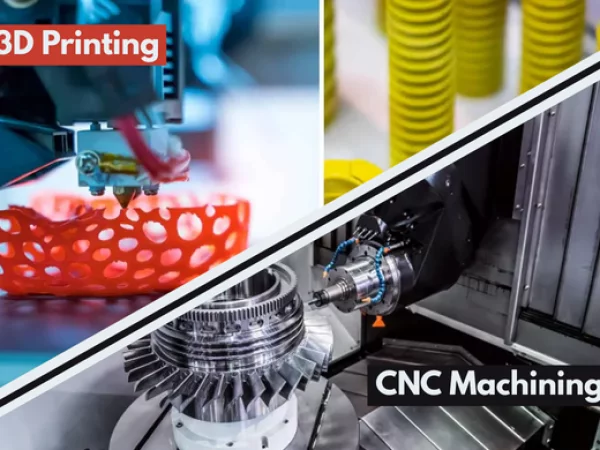
The core difference is direction. CNC machining is subtractive: it starts with a solid block of material and cuts the part out using mills, lathes, and other tools. 3D printing is additive: it builds the part up layer by layer from filament, resin, or powder.
That difference drives everything else. Cutting from solid stock gives a machined part the full strength of the raw material and a smooth, accurate surface, but it limits how complex the internal geometry can be. Building layer by layer lets a printer create shapes that no cutter could reach, such as internal channels and lattices, but the layered structure can leave the part weaker and rougher than a machined equivalent.
Precision and Surface Finish
CNC machining holds tighter tolerances. Typical CNC work lands around ±0.01 to 0.05 mm, and capable shops go tighter, with smooth surfaces straight off the machine. 3D printing is less precise, generally ±0.05 to 0.2 mm depending on the technology, with SLA at the accurate end of the range. Printed parts also show layer lines and usually need post-processing such as sanding or bead blasting to smooth the surface.
If your prototype has to mate with other components, seal, or be measured against tight drawing tolerances, CNC is the safer choice. If the surface and fit are not critical at this stage, printing is fine.
Material and Strength
This is often the deciding factor. A CNC-machined part has the same properties as the solid billet it was cut from, so it behaves predictably under load. CNC also works across a wide range of metals and engineering plastics, including aluminum, steel, titanium, and high-strength polymers.
3D printed parts behave differently from the same material in solid form. Layer bonding creates directional, or anisotropic, properties, so a printed part can be weaker along the layer axis, and printed metal made by processes like DMLS can run lower in strength than wrought metal because of porosity. For functional or load-bearing prototypes that need real material performance, CNC machining is usually the better fit. For parts where moderate or directional strength is acceptable, printing works well.
Speed and Cost by Volume
For a single prototype, 3D printing is usually faster, since there is no fixturing or tool setup. Upload a file and print. CNC prototypes typically take a few days at most shops because of programming and setup, though the machined result is more accurate.
Cost flips with quantity. 3D printing has no tooling cost, which makes it cheap for one to a handful of parts. As volume rises, CNC becomes more economical per part because its setup cost spreads across the batch. A rough rule many shops use: for around 1 to 10 parts, printing is usually cheaper, and by roughly 25 or more parts, CNC is almost always cheaper per unit. Your exact crossover depends on part complexity and material.
CNC vs 3D Printing at a Glance
| Factor | Mecanizado CNC | Impresión 3D |
| Method | Subtractive (cut from solid) | Additive (built layer by layer) |
| Tolerancia | About ±0.01 to 0.05 mm or tighter | About ±0.05 to 0.2 mm |
| Acabado superficial | Smooth off the machine | Layer lines, often needs post-processing |
| Strength | Full billet strength, isotropic | Anisotropic, can be weaker by axis |
| Materiales | Wide range of metals and plastics | Thermoplastics, resins, some metal powders |
| Geometry | Limited by tool access | Excels at complex and internal features |
| Single part speed | Slower (setup) | Faster (no setup) |
| Cost at volume | Cheaper per part as quantity rises | Cheaper for one to a few parts |
A Simple Decision Path
Work through these in order:
- Does the part need tight tolerances, smooth surfaces, or full material strength? If yes, lean CNC, especially for metal and load-bearing parts.
- Is the geometry too complex for a cutting tool, with internal channels or lattices? If yes, lean 3D printing.
- How many do you need? One to a few favors printing; larger batches favor CNC.
- How fast do you need it and how often will the design change? Frequent iteration and same-day concepts favor printing; a stable design headed for functional testing favors CNC.
When the answers pull in different directions, a hybrid approach often wins. Print a part to validate complex geometry or to iterate quickly, then machine the production or test parts for strength and accuracy. You can also print a near-net shape and CNC-finish only the critical surfaces.
Where Rapidcision Fits
Because we run both processes, we can route your prototype to whichever one serves the part best, or combine them. Upload a design and our instant-quote workflow returns pricing for the right process along with DFM feedback, so you are not guessing. For more on how printed parts differ by technology, see our guide to FDM vs SLA vs SLS, or review the full range of approaches in rapid prototyping methods compared. When you are ready, upload your CAD file for a quote.
Preguntas frecuentes
Is CNC machining or 3D printing better for prototypes? It depends on the part. CNC machining is better for tight tolerances, smooth surfaces, and full material strength, especially in metal. 3D printing is better for complex geometry, single parts, and rapid iteration at low cost. Many teams use both.
Which is more accurate, CNC or 3D printing? CNC machining is more accurate, typically holding ±0.01 to 0.05 mm or tighter, while 3D printing generally holds ±0.05 to 0.2 mm depending on the technology. CNC also produces smoother surfaces without post-processing.
Which is cheaper for prototypes? For one to roughly ten parts, 3D printing is usually cheaper because it has no tooling cost. By around 25 or more parts, CNC machining is generally cheaper per unit as setup cost spreads across the batch.
Are 3D printed parts as strong as machined parts? Usually not. A machined part has the full strength of the solid material, while a printed part has anisotropic properties from layer bonding and can be weaker along the layer axis. Printed metal can also be lower in strength due to porosity.
Can I use both CNC and 3D printing on one project? Yes, and it is common. Teams often print to validate complex geometry or iterate quickly, then machine the functional or production parts. A part can also be printed near-net and CNC-finished on critical surfaces.
Which is faster for a single prototype? 3D printing is usually faster for one part because there is no setup. CNC prototypes typically take a few days due to programming and fixturing, but deliver a more accurate result.
Choosing the Right Prototype Process
CNC machining and 3D printing solve different problems. Reach for CNC when precision, strength, and surface finish matter, and for printing when geometry, speed on a single part, and rapid iteration matter. Match the process to the part’s tolerances, material, complexity, and volume, and consider a hybrid when the requirements pull both ways.
If you have a prototype to make and want a straight recommendation, upload your design for a quote. We will tell you which process fits, or whether a combination gets you a better part faster.