
Révisé par l'équipe d'ingénieurs de Rapidcision | Dernière mise à jour : juin 2026
FDM, SLA, and SLS are the three most widely used 3D printing technologies, and each is built for a different job. FDM melts and extrudes thermoplastic filament, and it is the cheapest option for concept models and functional parts where fine detail is not critical. SLA cures liquid resin with light, and it produces the smoothest, most detailed parts, ideal for cosmetic prototypes and fine features. SLS fuses nylon powder with a laser, and it makes the strongest, most durable functional parts, with no need for support structures. If you need cheap and fast, look at FDM. If you need fine detail and smooth surfaces, look at SLA. If you need tough, functional parts, look at SLS.
This guide explains how each process works, what materials and properties to expect, and how to choose. We run all three through our 3D printing services, and matching the technology to the part is what separates a useful prototype from a wasted print.
How Each Process Works
FDM (Fused Deposition Modeling) builds a part by melting a thermoplastic filament and depositing it in thin layers that fuse as they cool. It is the most common and accessible 3D printing method, and it works with a broad range of filaments.
SLA (stéréolithographie) builds a part from liquid photopolymer resin held in a vat. A UV laser or light source selectively cures a thin layer of resin to match each cross-section of the design, then the build platform moves and the next layer cures on top. The result is exceptionally smooth and detailed.
SLS (frittage sélectif par laser) builds a part inside a bed of fine nylon powder. A laser sinters, or fuses, the powder where the part is solid, layer by layer, while the surrounding loose powder supports the part. Because of that powder support, SLS needs no separate support structures, which frees up complex geometry.
Matériaux
FDM offers the widest everyday material choice: PLA, ABS, PETG, nylon, polycarbonate, and composite filaments such as carbon-fiber-reinforced grades for added stiffness. That range makes it flexible for both concept and functional parts.
SLA uses photopolymer resins, available in standard, tough, heat-resistant, flexible, and castable formulations. The tradeoff is that standard resins are more brittle than engineering thermoplastics, so for parts under mechanical stress you need an engineering-grade resin, and even then SLA does not match the toughness of materials like nylon or polycarbonate.
SLS primarily uses nylon powders such as PA12 and PA11, including glass- or carbon-filled versions for extra strength. These materials produce durable, functional parts with good chemical and heat resistance.
Detail, Strength, and Finish
The three technologies trade off against each other in a predictable way.
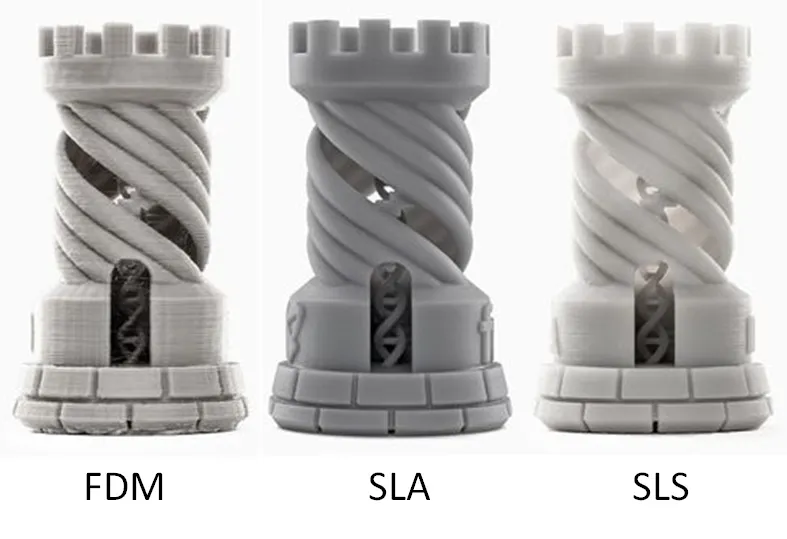
SLA leads on resolution and surface finish. Because the resin cures without thermal expansion, SLA holds fine features down to around 0.1 mm with smooth surfaces close to injection-molded quality, and its parts are isotropic. Its weakness is mechanical: standard resin parts are brittle and not ideal for functional load testing.
SLS leads on functional strength. Its parts are durable, hold up under real-world use, and behave consistently because they are largely isotropic, which suits snap-fits, living hinges, and low-volume end-use parts. The surface is a fine matte, grainier than SLA but perfectly usable.
FDM is the most economical and prints the largest parts, and modern machines produce solid functional prototypes. Its limitations are visible layer lines and anisotropy, since the bond between layers is the weak direction, so an FDM part is strong in plane but weaker across layers.
FDM vs SLA vs SLS at a Glance
| Facteur | FDM | SLA | SLS |
| Process | Melts and extrudes filament | Cures liquid resin with light | Sinters nylon powder with a laser |
| Matériaux | PLA, ABS, PETG, nylon, PC, composites | Photopolymer resins | Nylon powders (PA12, PA11), filled grades |
| Detail and finish | Lower, visible layer lines | Highest, very smooth | Good, fine matte |
| Force | Strong but anisotropic | Detailed but brittle (standard resin) | Strong, durable, functional |
| Support structures | Obligatoire | Obligatoire | Not required (powder bed) |
| Coût relatif | Lowest | Medium | Highest |
| Idéal pour | Concept and functional prototypes, larger parts | Cosmetic prototypes, fine detail, castable patterns | Functional prototypes, complex geometry, low-volume end use |
How to Choose
Start from what the part has to do.
Choose FDM for early concept models, fit checks, jigs, and functional prototypes where cost and turnaround matter more than fine detail, or when the part is large.
Choose SLA when appearance and precision lead, such as cosmetic prototypes, parts with fine features, dental and jewelry models, or castable patterns. Use an engineering-grade resin if the part will see any mechanical stress.
Choose SLS for functional prototypes and low-volume end-use parts that need durability and complex geometry, including snap-fits and assemblies with moving parts, where the lack of support structures is a real advantage.
If your part actually needs metal, full material strength, or tolerances tighter than printing reliably holds, Usinage CNC may be the better route. We cover that tradeoff in CNC machining vs 3D printing, and the broader set of options in Comparaison des méthodes de prototypage rapide.
Questions fréquemment posées
What is the difference between FDM, SLA, and SLS? FDM melts and extrudes thermoplastic filament, SLA cures liquid resin with light, and SLS fuses nylon powder with a laser. FDM is the cheapest, SLA gives the finest detail and smoothest finish, and SLS makes the strongest, most durable functional parts.
Which 3D printing technology is strongest? SLS generally produces the strongest, most durable functional parts and is largely isotropic. FDM parts are strong in plane but weaker across layers, and standard SLA resin parts are brittle, though engineering resins improve this.
Which 3D printing process has the best detail? SLA has the best resolution and surface finish, holding fine features down to around 0.1 mm with smooth surfaces close to injection-molded quality. SLS is good with a fine matte finish, and FDM shows visible layer lines.
Does SLS need support structures? No. The surrounding loose nylon powder supports the part as it builds, so SLS needs no separate supports. This lets it produce complex geometries and assemblies that would be difficult with FDM or SLA.
Which 3D printing method is cheapest? FDM is the most economical, both in equipment and materials, and it offers the largest build volumes. SLA sits in the middle, and SLS is the most expensive because of higher machine and powder costs.
Which technology should I use for functional prototypes? SLS is usually the best choice for functional prototypes because of its strength and durability. FDM also works for functional parts where directional strength is acceptable, while SLA is better suited to detailed or cosmetic parts than to mechanical testing.
Choosing the Right 3D Printing Technology
FDM, SLA, and SLS each earn their place. FDM is the economical workhorse for concept and functional parts, SLA is the detail and finish specialist, and SLS is the choice for tough, complex, functional parts that need no supports. Match the technology to the part’s detail, strength, and budget, and you get a print that does its job.
If you are not sure which process fits, Téléchargez votre projet pour obtenir un devis. We will recommend the right 3D printing technology, or CNC machining, based on your part’s requirements.