 Skip to content
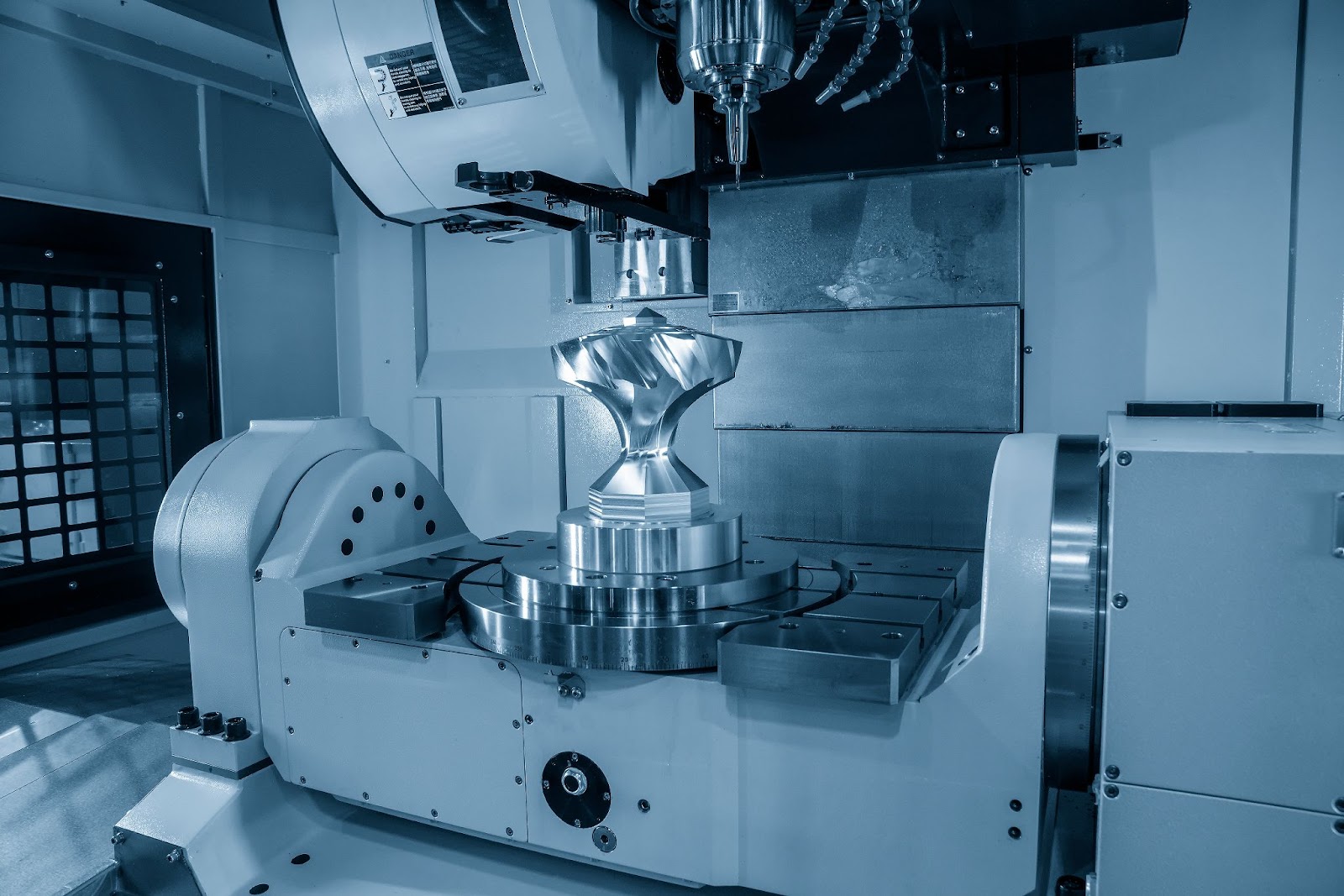
5-axis CNC milling moves the cutting tool along five simultaneous axes, letting suppliers machine complex parts in a single setup instead of three or four. That cuts setup time by 40-80%, improves positional accuracy between features, and produces better surface finishes on contoured geometry. Hourly rates run $75-$300 depending on machine class and part complexity, but total part cost is often lower than 3-axis for multi-sided components because you’re paying for fewer setups and less scrap. This guide covers how 5-axis works, when your project actually needs it, what it costs, and how to evaluate a supplier.
Most parts don’t need 5-axis machining. A flat bracket with a few holes and a pocket? That’s a 3-axis job, and paying 5-axis rates for it is a waste of money. But a turbine blade with compound airfoil surfaces, an impeller with deep channels between thin vanes, or a structural bracket with mounting features on three different planes? Try machining those in a single setup on a 3-axis mill. You can’t.
That’s the line 5-axis CNC milling exists to cross. The global 5-axis CNC machine tool market hit $11.25 billion in 2026, and roughly 68% of US aerospace and defense manufacturers now rely on these systems for precision components. The technology isn’t new, but it’s no longer reserved for exotic aerospace work. Medical devices, automotive prototyping, energy components, and even consumer electronics now use 5-axis milling regularly.
If your team is sourcing CNC machining services and wondering whether your part actually needs 5-axis, this guide will help you figure that out, understand what it costs, and know what to look for in a supplier.
What Is 5-Axis CNC Milling and How Does It Work?
5-axis CNC milling uses a cutting tool that moves along three linear axes (X, Y, Z) and two additional rotational axes (typically A and B), allowing the tool or workpiece to be oriented in virtually any direction during a single clamping. This means a part can be machined on five sides without being unclamped and repositioned.
In a standard 3-axis mill, the cutting tool moves up-down, left-right, and forward-back. That covers flat surfaces, pockets, holes, and basic 3D contours. But the tool can only approach the workpiece from above. If you need features on the sides or bottom, you unclamp the part, flip it, re-indicate it, reclamp, and run a new program. Each flip is a separate setup.
5-axis adds rotation. The two extra axes let the tool (or the table holding the workpiece) tilt and swivel during cutting. There are three main machine configurations that accomplish this differently:
Trunnion style rotates the workpiece on a cradle. The spindle stays vertical while the table tilts and spins the part into position. This is the most common configuration for small to medium parts. It offers excellent rigidity and repeatability.
Swivel-head style keeps the workpiece stationary and rotates the spindle head instead. Better for large, heavy parts where moving the workpiece would compromise stability.
Table/table style uses two rotary axes built into the table itself. Common in double rotary table setups used for precision medical and optical components.
The practical result across all three configurations: your part gets machined from multiple angles without anyone touching it between operations. That matters more than most people realize.
When Does Your Project Actually Need 5-Axis Milling?
Your project needs 5-axis milling when the part has features that can’t be reached from a single direction, when holding position tolerance between features on different planes is critical, or when the geometry involves complex contoured surfaces that require continuous tool-angle adjustment. If your part can be fully machined from the top in one or two setups, 3-axis is the right call.
Here’s the decision logic your team should use.
You need 5-axis if your part has undercuts, deep pockets with angled walls, compound curved surfaces, or mounting features on three or more planes that need to hold tight positional tolerance to each other. Turbine blades, impellers, aerospace structural brackets, orthopedic implants, and complex mold cavities are classic 5-axis applications. These parts physically cannot be completed in one or two 3-axis setups without sacrificing accuracy.
You probably need 5-axis if your part requires a high-quality surface finish on contoured geometry. In 3-axis, the tool approaches at a fixed angle, which creates cusping (scallop marks) on curved surfaces. 5-axis lets the tool tilt to maintain optimal contact with the surface, producing smoother finishes directly off the machine and reducing post-processing.
You don’t need 5-axis if your part is flat or prismatic with features accessible from one direction. Simple brackets, plates, spacers, and basic housings are all 3-axis parts. Sending these to a 5-axis machine doesn’t improve quality. It just costs more.
The grey area is multi-sided parts that could be done with 3-axis using multiple setups. A part with features on three sides could be machined in three 3-axis setups or one 5-axis setup. The math depends on volume, tolerance requirements, and setup cost. For prototypes and low volumes, 5-axis often wins because setup time dominates the cost. For high-volume production of simpler parts, 3-axis may still be cheaper per piece.
How Much Do 5-Axis CNC Milling Services Cost?
5-axis machine rates typically range from $75 to $300+ per hour depending on machine class, material, and precision requirements. Standard 3-axis rates run $35 to $100 per hour. But hourly rate alone is misleading. Total part cost is what matters, and 5-axis often delivers a lower total cost on complex parts because it eliminates setups.
Let’s break down where the money actually goes.
Machine time is the most visible cost. 5-axis machines cost more to buy ($150,000 to $500,000+), require specialized CAM software ($15,000 to $50,000 annually), and need operators with 2-3 years of additional training beyond basic CNC skills. Shops recover those investments through higher hourly rates.
Setup time is where 5-axis changes the economics. A part that needs four setups on a 3-axis machine (unclamp, flip, re-indicate, reclamp, load new program) might need one setup on a 5-axis. MS Machining reports that 5-axis can reduce cycle times by 60-80% for multi-sided parts. At low volumes, setup time often costs more than machining time. Eliminating three of four setups can offset the higher hourly rate entirely.
Fixturing gets simpler with 5-axis. Multi-setup 3-axis work often requires custom fixtures for each orientation. 5-axis typically uses a single fixture, sometimes just a standard vise. Less fixturing means lower tooling cost and faster job start.
Scrap risk drops with fewer setups. Every time a part gets unclamped and repositioned, there’s a chance of introducing positional error. On a tight-tolerance part, that error can push features out of spec. One setup on 5-axis eliminates that risk layer entirely.
The total cost comparison depends on part complexity. For a simple aluminum bracket, 3-axis at $50/hour for 2 hours beats 5-axis at $150/hour for 1 hour. But for a titanium aerospace bracket with features on five sides, 5-axis at $200/hour for 3 hours beats 3-axis at $75/hour for 12 hours across four setups with custom fixtures. Run the total math, not the hourly math.
What Materials Can Be 5-Axis Milled?
5-axis CNC milling handles the same material range as 3-axis: aluminum alloys, titanium, stainless steel, Inconel, copper, brass, and engineering plastics like PEEK and Delrin. The machine configuration doesn’t limit material choice. What changes is how effectively the 5-axis capability handles difficult-to-machine materials.
Aluminum (6061, 7075) machines beautifully on 5-axis. High spindle speeds, aggressive feed rates, and the ability to maintain optimal tool engagement angle on contoured surfaces all play to aluminum’s strengths. Aerospace structural components, heat sinks, and complex housings are common 5-axis aluminum applications.
Titanium (Ti-6Al-4V) benefits significantly from 5-axis. Titanium generates concentrated heat at the cutting edge due to low thermal conductivity. 5-axis allows the tool to maintain a consistent chip load and optimal cutting angle throughout complex geometry, which improves tool life and surface finish compared to repositioning on 3-axis where entry angles change with each setup.
Stainless steel (304, 316, 17-4PH) and nickel superalloys (Inconel 718) are common 5-axis materials for energy, medical, and aerospace parts. The ability to use shorter, more rigid tools (because the machine can tilt to reach features instead of using long-reach tools) reduces deflection and chatter on these tough materials.
Engineering plastics (PEEK, Ultem, Delrin, PTFE) require careful handling on 5-axis because they’re prone to thermal distortion and flexing under cutting forces. But the benefit of single-setup machining is significant for plastic parts with features on multiple faces, since plastics deform easily when reclamped.
The general rule: if the material can be CNC milled on 3-axis, it can be milled on 5-axis. 5-axis doesn’t expand material compatibility. It expands geometric capability and improves process control on difficult materials.
Which Industries Use 5-Axis CNC Milling Services?
The short answer: any industry where parts have complex geometry, tight tolerances, or multiple machined faces that need to relate precisely to each other. Here are the sectors driving the most 5-axis demand.
Aerospace and defense is the largest consumer. Turbine blades, impellers, wing ribs, structural brackets, compressor housings, and missile components all require 5-axis to achieve the contoured surfaces and multi-plane features these parts demand. AS9100D-certified 5-axis work is a specific niche within this market.
Medical devices rely on 5-axis for orthopedic implants (hip cups, knee components, spinal cages), surgical instruments, and prosthetics. These parts often have organic, patient-specific geometries that are impossible to produce with 3-axis machining. The surface finish quality that 5-axis delivers is particularly valuable for implants that contact biological tissue.
Automotive and motorsport uses 5-axis for engine components, turbocharger housings, transmission cases, cylinder heads, and rapid prototypes. Performance and racing applications especially benefit because parts need complex internal passages and lightweight structures that only 5-axis can machine efficiently.
Energy and industrial sectors machine turbine disks, pump housings, valve bodies, and heat exchanger components on 5-axis systems. These parts are typically large, made from tough materials, and require precise internal geometry.
Mold and die making was one of the earliest adopters of 5-axis for machining complex cavity surfaces. Deep-draw molds, multi-cavity injection molds, and blow mold tooling all benefit from the ability to reach deep features with shorter tools and better surface finishes.
How to Choose a 5-Axis CNC Milling Supplier
Not every shop that owns a 5-axis machine is good at using it. The gap between having the equipment and having the process maturity to run complex 5-axis work consistently is wider than most buyers expect.
Check their 5-axis experience level, not just machine count. Ask how many years they’ve been running production 5-axis work and what industries they serve. A shop that bought a 5-axis machine last year and runs basic 3+2 positioning work has a different capability profile than one that’s been doing continuous simultaneous 5-axis for aerospace parts for a decade.
Understand the difference between 3+2 and simultaneous 5-axis. In 3+2 (also called positional 5-axis), the two rotary axes lock into position and the machine cuts using only 3 axes. The part gets indexed to a new angle, then more 3-axis cutting happens. This works well for multi-sided prismatic parts. Simultaneous 5-axis moves all five axes at once during cutting, which is required for continuous contoured surfaces like turbine blades and impellers. If your part needs simultaneous 5-axis and the shop only does 3+2, you’ll have problems.
Ask about their CAM programming capability. 5-axis programming is substantially more complex than 3-axis. It requires specialized software, collision avoidance verification, and experienced programmers who understand tool-path optimization for multi-axis motion. Shops with weak programming produce parts with visible tool marks, inconsistent surfaces, and longer-than-necessary cycle times.
Verify inspection capability. Complex 5-axis parts often have features that can’t be fully verified with basic measurement tools. In-house CMM capability with experienced operators is important for verifying positional relationships between features machined from different angles.
Request DFM feedback before committing. A capable 5-axis supplier will review your part and tell you whether 5-axis is actually necessary, suggest design changes that reduce machining time, and identify potential collision or access issues. If the response is just “we can make it,” keep looking.
Evaluate prototype-to-production capability. If your program starts with prototypes and scales to volume, a supplier who handles both avoids requalification cost and ensures process consistency from first article through production.
Conclusion
5-axis CNC milling solves a specific set of problems: complex geometry that can’t be reached from one direction, tight positional tolerances between features on multiple planes, and contoured surfaces requiring continuous tool-angle control. It doesn’t make every part better or cheaper. It makes complex parts possible and, in many cases, more economical than the alternative of multiple 3-axis setups.
Three things to remember when sourcing 5-axis work. First, evaluate total part cost, not hourly rate. A higher rate with fewer setups often beats a lower rate with four fixture changes. Second, match machine capability to part complexity. Simple parts on 5-axis is overspending. Complex parts on 3-axis is under-engineering. Third, verify that your supplier has real 5-axis programming depth and production experience, not just the machine.
If your team has a part with complex geometry or multi-plane features that needs precision machining, get an instant quote from Rapidcision to see pricing, lead times, and DFM feedback for your project.
Frequently Asked Questions
What is the difference between 3+2 and simultaneous 5-axis machining?
In 3+2 machining, the rotary axes lock into a fixed angle and the machine cuts using only three linear axes. The part gets repositioned to a new angle for the next operation. In simultaneous 5-axis, all five axes move continuously during cutting. 3+2 works for multi-sided prismatic parts. Simultaneous 5-axis is required for continuous contoured surfaces like turbine blades and impellers.
How much does 5-axis CNC milling cost per hour?
Rates typically range from $75 to $300+ per hour depending on machine class, material, and precision requirements. Standard 3-axis rates run $35 to $100 per hour. But hourly rate is misleading on its own. Total part cost depends on setup count, cycle time, fixturing, and scrap risk. Complex parts often cost less total on 5-axis despite the higher hourly rate.
When should I use 5-axis instead of 3-axis machining?
Use 5-axis when your part has features on three or more sides that need tight positional tolerance, when geometry includes continuous contoured surfaces, or when 3-axis would require four or more setups. If your part is flat or prismatic with features accessible from one direction, 3-axis is the more cost-effective choice.
What tolerances can 5-axis CNC milling achieve?
5-axis machines can hold tolerances of ±0.0001″ on high-end equipment, though ±0.001″ to ±0.005″ is more typical for production work. The precision advantage of 5-axis comes primarily from single-setup machining, which eliminates the positional error introduced by reclamping between setups on multi-axis parts.
What materials can be machined on a 5-axis CNC mill?
Any material that works on 3-axis works on 5-axis: aluminum, titanium, stainless steel, Inconel, copper, brass, and engineering plastics like PEEK and Delrin. 5-axis doesn’t expand material compatibility. It expands geometric capability and often improves tool life and surface finish on difficult materials by maintaining optimal cutting angles throughout the operation.